


Charting a planet of symbiosis
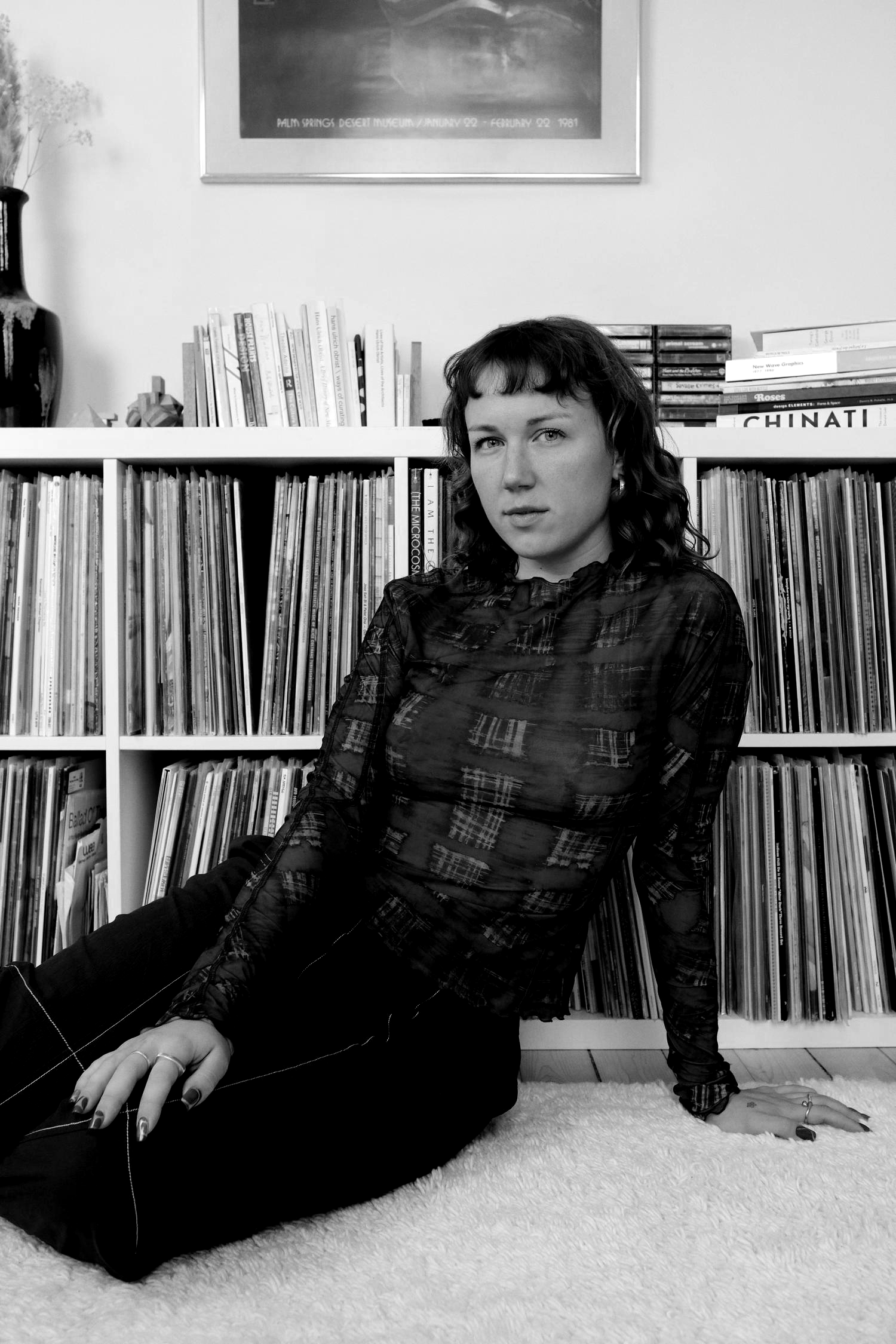
Sarah is a Curator, Cultural Strategist, and Creative Director exploring the intersections of art, technology, and policy. She directs MUTEK's innovation and professional programs, including the annual MUTEK Forum, Future Festivals think tank (co-lead), and AI Ecologies Lab - an initiative challenging artists to build more sustainable AI tools for the cultural sector. Over the past decade, she has spearheaded culture projects for creative studios, brands, and media outlets, including the Red Bull Music Academy, CHANEL, Coach, Venice Biennale of Architecture, Asahi, CBC, and many others. She is also five years into a documentary on analog photo booths that has quietly become a meditation on the coexistence of analog and digital.
Build a "planet of symbiosis" where tech serves humanity
What the landing requires
- A new vocabulary centered on reciprocity over extractivism.
- Public policy that values culture as critical infrastructure, and not an ornament.
- Alliances with ecological, non-Western, and Indigenous knowledge systems, embedded in decision-making.
Curation as slow infrastructure: refuse the inevitability narrative, build landing pads where critical curiosity meets unexpected alliances, and trust emergence to do what no plan could.
cultural programming · AI governance · ecological ways of knowing · artist-led research · analog materiality
Transmission 01
Charting a planet of symbiosis
What planet are you currently exploring, and why now?
In many ways, I'm trying to navigate the tension between humanity and technology across all of my projects. The planet I'm currently exploring is defined by symbiosis. Down there, our bodies, or people's bodies, have different relationships to technology and to other inhabitants. The natural environment, or the physical environment in the natural world, feels very deeply interconnected rather than extractive. This planet that I'm currently on, I'd say, feels further than I'd like from planet Earth, but also not completely out of reach. So it doesn't necessarily feel like a utopia, but it's more like a destination that keeps drawing me back. For the past couple of years, this exploration has taken shape through my active work in the ethical AI space and in programming the MUTEK Forum, which has been incredible. By working directly with artists and also being part of really strategic, high-level policy discussions about governance as it pertains to AI.
And I just feel there's no way to come back from this planet that I'm exploring. I've felt this tension between creativity, humanity, and big tech for so long that it feels like something so near and dear to my core in everything I do, even in this film I'm also making.
The work I'm doing right now feels like temporary landing pads where people can think together without the logic of speed and scale dictating the terms.
You've been on this trajectory for a few years. Have you adapted your approach to that terrain?
As I started working and curating conferences, I noticed more and more that it's sometimes really impossible to silo certain conversations we're having about technology and culture. The real opportunities, the real magic, happen when you can be multidisciplinary, interdisciplinary, and cross over different industries in a surprising way. When you manage to create these connections between people who didn't know it was previously possible.
So, why wouldn't we have a conversation about machine learning and Indigenous methodologies at the same time? Why wouldn't we have a conversation about gaming and sustainability at the same time? I think what's really evolved for me is that I'm constantly chasing after these really creative, fun ways to mash up conversations that will hopefully have a greater impact down the line.
What drew you to leave familiar ground and board this mission?
For the first 10 years of my career after university, alongside journalism projects, I was working considerably in the private sector, for big brands and advertising. It was during the pandemic that I had an experience with my previous employer, where I faced a massive ethical conundrum over a decision they made around the Black Lives Matter movement. That completely changed my life. I decided to walk away from the very cushy job I had to pursue work and projects on my own terms, which inevitably brought me closer to my values. It was terrifying at the time, but I now see it as a gift! And from that moment, I started working in journalism and critiquing existing technologies.
I started reporting on AI for the CBC in 2020, while also working on a documentary about crypto LARPers (yes, that’s a thing). I just started diving into these rabbit holes of the implications of emerging advanced technologies, investigating how humans were connecting with them and what kinds of communities were emerging from that. This led me into new spaces, where I met more people who were also refusing to submit to this extractive logic that big tech keeps trying to normalize as inevitable.
I'm not perfect! I sometimes work within these systems, but I just can't stay comfortable in spaces that don't ask the harder questions. The more I've learned about what's actually at stake, the more humbling it's become.
Today, my whole mantra is that I don’t really want to live on a planet where we work for technology, where we work for AI. AI should work for us on our own terms, respecting our agency.
From orbit, what patterns or forces shape this world?
When I read this question earlier, I had a lot of visuals in my mind. Wouldn't it be incredible if we could live on a planet so symbiotic that it was shaped by elemental forces rather than extracted ones? It feels like a crazy thing to say, or to say out loud, but it's true.
Now, these patterns are so embedded in our lives that we feel completely trapped by these algorithms. The same hits of dopamine. And I think it would be incredible to untether ourselves from our attachments to technology and completely ground ourselves in connection with our environment. It still feels very challenging for us now, but it’s something that I would absolutely love to see on this new planet that I'm orbiting towards.
Again, it's really about symbiosis, but it's not necessarily about letting go of screens. It's more about recalibrating our relationships with our natural world and our physical environment.
Are there peer institutions gravitating in the same orbit you are watching closely?
I have been very inspired in the past few years by many people I've met, but especially by learning how Indigenous communities are working with AI. The Indigenous use cases with AI are the best I have seen.
For example, I was at the National Summit for AI and Culture at the Banff Centre in March 2026, and this was the first time that Patrimoine Canada had formally gathered around 200 thinkers to discuss how AI should intersect with culture. Many use cases were presented on how organizations, nonprofits, and private companies were using AI in the cultural sector. But the most incredible use cases came from Indigenous folks who were using AI to teach endangered languages, while also creating models that could help non-Indigenous organizations authentically integrate Indigenous protocols. This is exactly how we should be using the technology.
Half the time we use AI, we don't actually need it. Meanwhile, there's a whole culture doing compelling work on ecological thinking, exploring more sustainable modes of AI: tiny models and other approaches run locally rather than through massive centralized infrastructure. We don't have to expend nearly as much energy in our everyday use of AI as we're led to believe, and that's been inspiring to me.
Why do you think so few people are landing there?
Having to consider this tension between human creativity and machine across diverse contexts, or to rethink our use of technology through a critical lens, requires holding contradictions without resolving them.
The dominant narrative that acceleration is neutral and that scale is success is seductive because it removes the burden of choosing. And, of course, discomfort does not equate to the scale some organizations might seek. And on the other side, neither does the alternative if we don't fight for it.
With MUTEK, we are a non-profit, and our values are at the core of everything we do. MUTEK's values are my values, and vice versa. And so, in the context of a festival and an institution, I do think there is a certain responsibility: the programming, the messages, the different stakeholders involved, and everything coming out of the institution help shape the future or move things forward.
More specifically, when it comes to public institutions or publicly funded institutions. They have a responsibility to raise awareness of these topics: the negative impacts of technology, the existence of alternative solutions, and people's willingness to settle on these alternative planets.
But it's going to take time and involve facing resistance that needs to be met with coexistence.
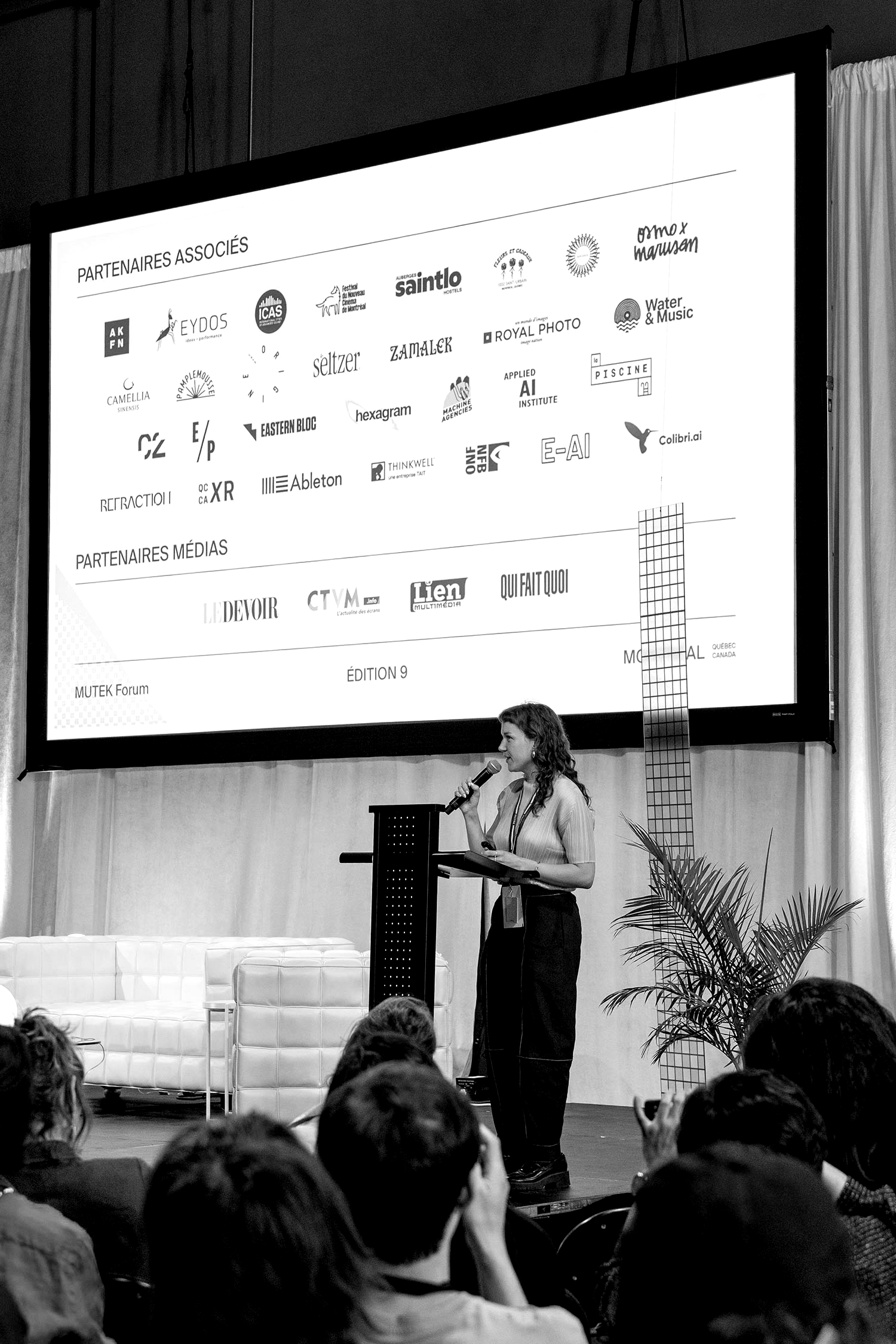
What does the ground actually look like once you get close? For example, a session that really worked at Mutek Forum 2025, and then the inverse, one that didn't land.
My favorite talk at the Forum last year was a performance lecture by Alice Bucknell, an incredible game artist and educator based in Los Angeles. They presented a new kind of iteration of this in-game lecture called All the Worlds Polygons, where we were brought into Unreal Engine. The room was in darkness. Then, for 45 minutes, they brought us into the screen setup they had on stage, and we explored ecological simulation in gaming, the bleed between entertainment and climate forecasting, and the paradox of predictive technologies in foreclosing other possible futures.
It offered a beautiful, poetic glimpse into the tension between extractivism and technology.
This talk was followed up by a keynote presentation from a sponsor. It was very jarring. But, at the end of the day, well, we wouldn't have been able to have Alice if it weren't for the sponsor. So many things to be said about that, right? This feeds back into the tensions we've been discussing so far.
What are you carrying with you on this journey?
Lots of snacks, a journal, and Tide to Go. I always have Tide to Go with me wherever I go…
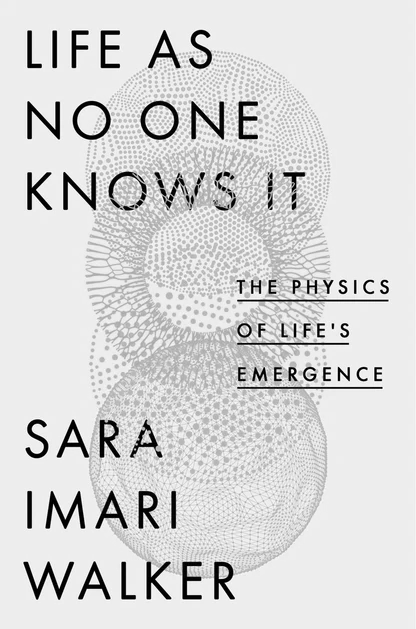
I also want to plug two books I've recently read that have changed my life. The first is Life As No One Knows It: The Physics of Life's Emergence by Sara Imari Walker. My most current rabbit hole is around quantum physics, matter, and different forms of consciousness, and I've been really interested in how we define life, which turns out to be very difficult depending on who you ask, especially a physicist! It's not a difficult read, so I'd highly recommend it. It's existential in a way that's extremely grounding and thought-provoking.
The second book I want to plug is by our good old friend Philip K. Dick, How to Build a Universe That Doesn't Fall Apart Two Days Later. It's a quick read, based on a talk he gave in 1978. It's similar to Life As No One Knows It in that it's also questioning something we assume we already understand, in Walker's case, what counts as life, in Dick's case, what counts as real. It's set against the backdrop of a surrealist Disneyland, following him on a quest for an authentic human experience within a highly mediated universe. Very, very relevant to our present day.
These two books together serve as really important prompts for building our own frameworks for living in and around technology.
What helps you navigate when the terrain becomes unstable?
I'm a fearless multitasker in the sense that I am constantly working on many different projects, across many different media, forms, and stages. At the end of the day, I'm really interested in technology, people, and society, and that is the throughline that connects everything I do.
The terrain is often unstable because there are endless obstacles with creative work. For me, it’s helpful to ask whose urgency I'm serving, especially when everything is moving so fast in life. I need to always return to that question. Especially with the film that I've been working on for five years now. It's the longest I've ever worked on a project, and it's taught me so much about patience, trusting the process, and my relationship with technology.
The film Picture Yourself, which will be available to watch on Crave in 2027, was always meant to be, and still is, a love letter to vintage analog photobooths. When we first set out to make it, the idea was to highlight how analog photography is superior to digital photography, and to reveal the drawbacks of digital culture along the way.
Over time, though, spending countless hours with analog purists all over the world, people with zero patience for anything digital, and so much time traveling to film with them, people of all ages and backgrounds, sent me on my own journey. I started asking myself: how do I actually feel about digital in relation to analog? Are those two things really mutually exclusive?
Where I've landed, both with the film and in my own opinion, is that analog and digital need each other to exist. One doesn't really exist without the other; they should coexist rather than compete.
So, connecting back to your previous point: when things get murky, or I'm feeling a little lost in everything I'm doing, I remind myself that I'm in a constant state of curiosity, in flux, in exploration mode across everything that I do, and that if the terrain isn't stable, there's maybe an opportunity for change there, a chance to have my world opened up a little more, and often to surprise myself in ways that completely reroute my creative process and output.
What would a safe landing on the planet you are exploring require?
At the beginning of the conversation, we were talking a lot about extractivism. I think it would be interesting to have a completely new kind of vocabulary, a language oriented toward reciprocity.
We need policies that value culture far more than they currently do, treating it less as ornamental and more as fundamental, critical infrastructure.
Then, to back that up, we need institutions actually built to support it, ones capable of holding space for the work over the long term, in a context where there's no built-in exit strategy.
Beyond that, we need more alliances to foster connections and collaborations among ecological, non-Western, and Indigenous knowledge systems.
Is there a successor practice you are deliberately making space for?
I think about this constantly with my work at MUTEK. My voice, perspective, and experience alone aren't enough to put together the Forum, I need more diverse voices and a younger generation embedded in the programming every year.
That's why I've been working with an Indigenous curator for three years now, Kahentawaks Tiewishaw from Revital Software. We regularly bring in guest curators for the Forum, and I couldn't do this work without them; it's essential. Part of my responsibility is sharing space, from the ground up, with people who bring different voices, connections, and ideas to the program. We need to be working this collaboratively anyway.
Bringing this back to the photobooth documentary: one thing that's surprised me is how many of the people I've met who are passionate about saving analog technology are Gen Z. They weren't even around for the heyday of analog photobooths, but they're obsessed with preserving this vintage technology. I'm seeing the same patterns with youth movements rejecting AI. There's a broader current of young people pushing back against being handed technology as an inevitability. You see it with groups like the Luddite Club in New York, teenagers who've deliberately ditched smartphones and social media, not out of nostalgia, but because they want more agency over their attention and their relationships. It’s quite revealing!
What signal would you like to transmit to future explorers?
Ask as many questions as you possibly can. Being critical is just as important as being curious, especially for younger generations building the world they want to live in with this technology.
Part of me wants to say: go touch grass, plant something, be in nature. But just as much, I want to help you think critically about technology. With AI putting answers at our fingertips, knowing where that information actually comes from and building a filter to question it will matter enormously.
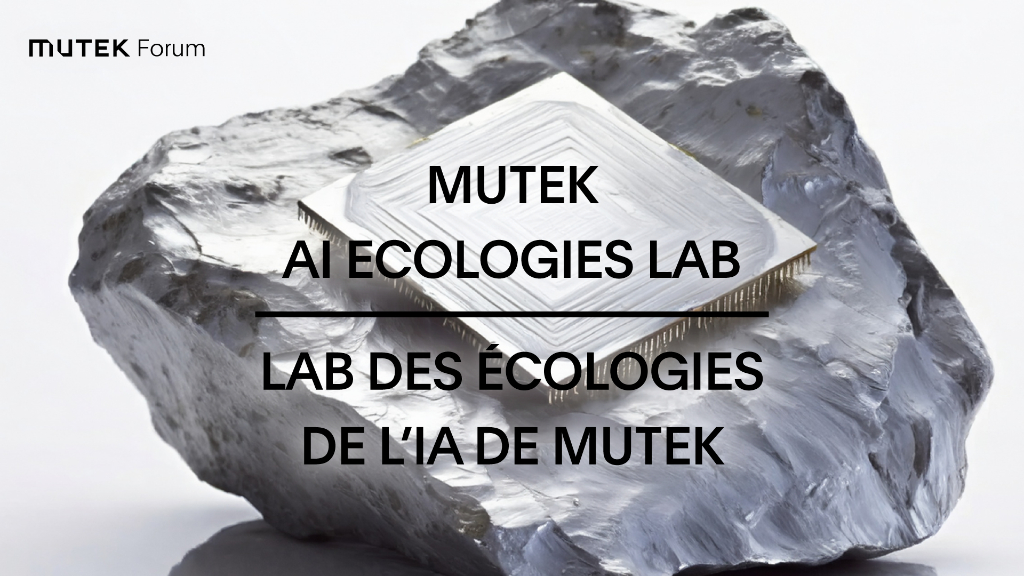
That's exactly what the AI Ecologies Lab, the program I led at MUTEK last year, was built around. We mandated artists to create AI tools that offered more sustainable alternatives to how AI was being used in the cultural sector. In the very first session, before anything else, we asked them to stop and answer one concrete question: why AI in the first place? If they couldn't, the program wasn't for them.
That's the question I still ask myself every time I'm about to use AI for something: do I actually need this, or am I just reaching for it? Most of the time, the honest answer is no.